
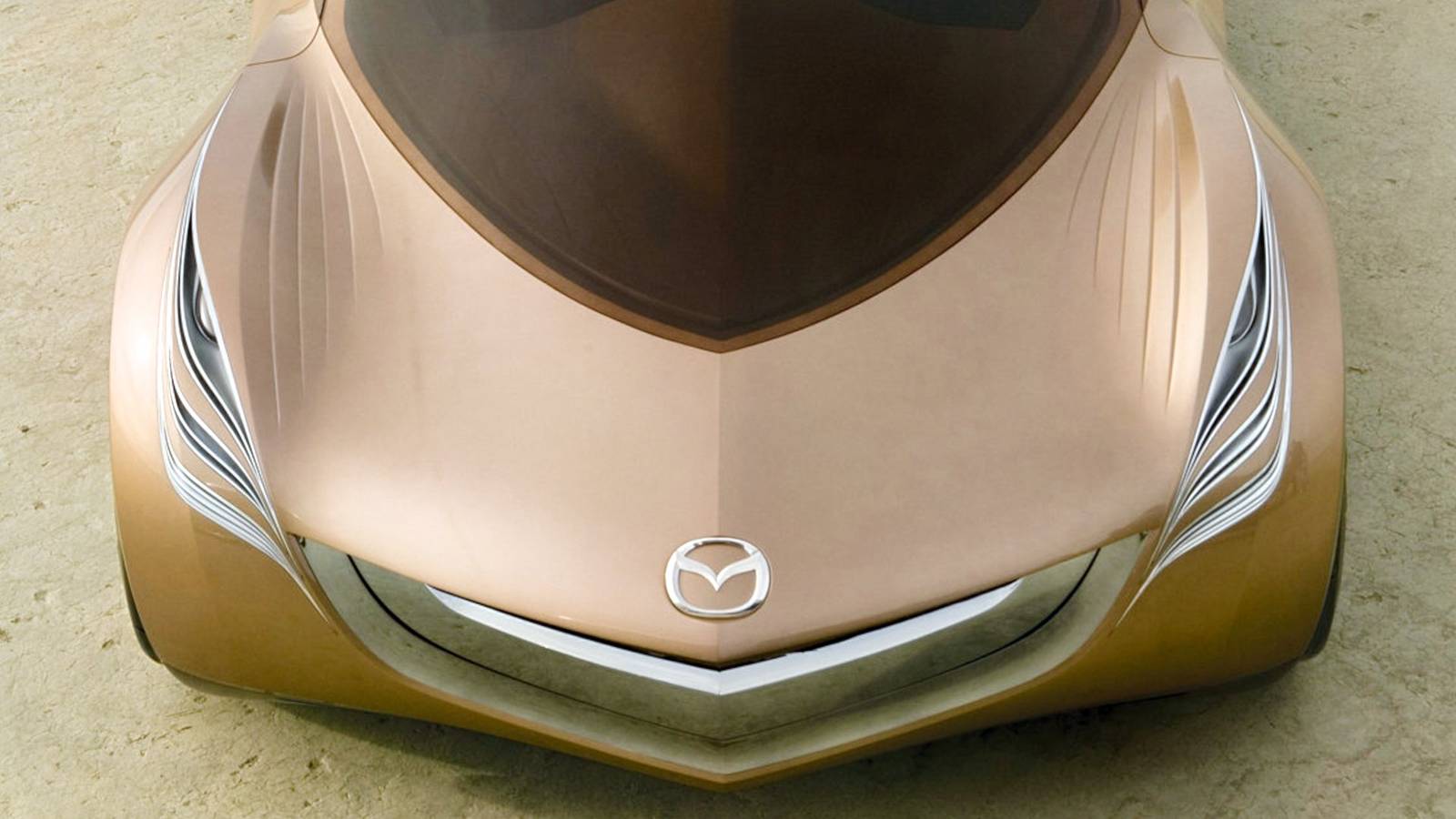
Mazda’s approach to design is a fascinating one. The company is famous in the automotive world for creating distinct design languages, each one with its own unique character. The company is also known for drawing inspiration from a variety of aesthetic sources, including the natural world, as well as the principles that guide the styling process.
One design language that the company explored extensively through concept cars, but did not find a home in Mazda’s production lineup, was Nagare, meaning “flow” in English. The earliest Mazda vehicle to make use of this look was a striking, one-of-a-kind concept car, which also carried the Nagare name.
Shortly after its introduction, it became the first of a series of related concept cars that showcased Mazda’s creative and meticulous approach to automotive design. Let’s take a closer look at the Nagare concept car, and the design language it represented.

The Mazda Nagare Concept: A Blend Of Nature And Tech

|
Mazda Nagare Concept Specs |
|
|
Year Released |
2006 |
|
Engine (conceptual idea) |
Hydrogen-powered rotary engine |
|
Seats |
4 |
|
Doors |
2 |
The Mazda Nagare concept car was unveiled in 2006 at the Los Angeles Auto Show. It was the first concept car produced by Mazda to use this new design language. The styling came from Dutch automotive designer Laurens van den Acker, who was Mazda’s global design director at the time, along with the automaker’s advanced design team at the company’s studio in Irvine, California.

The world of liquids influenced the Nagare’s design. Mazda’s design team looked at the way liquids behave, drawing inspiration for the car’s smooth, flowing lines. The result is a style that gives the illusion of movement even when the vehicle is stationary.
The windshield is angled in a way that seamlessly integrates it into the roof, for a sweeping, dynamic look. The wheels are integrated into the body, with wrap-around wheel wells that further emphasize the car’s smooth, aerodynamic look. Inside the car, we find a unique seating layout. The driver’s chair is on its own at the front, while the three passenger seats are arranged in a lounge-like wraparound layout at the rear.
The Nagare concept never resulted in a corresponding production model, but it kickstarted a family of concept cars that carried the design language of the same name.
Wind And Flow: The Nagare Design Language And Family Of Concepts

After the Nagare concept car was released, the design language appeared on other concept cars but never found an outlet in the company’s road-going models. Only one production Mazda, the Premacy minivan (known outside Japan as the Mazda5), used this design language in its third generation, which was on sale between 2010 and 2018. A few of Nagare’s elements later showed up in other models, including the Mazda3 and the Mazda6.
The Nagare language was heavily focused on swooping lines and gentle curves inspired by nature. Very few straight lines or hard angles could be found in a car that used this language. Every part of the car’s design, from the lights to the roofline, was all about curved lines.

The Nagare was succeeded by six further concept cars that used the same design language. Four of them – the Ryuga, Hakaze, Taiki, and Furai – were introduced in 2007. The Ryuga (Japanese for “gracious flow”) stood out for its scissor doors and unusual interior layout. It had bucket seats in the front and a lounge area at the rear. The concept also had a flex-fuel engine, which ran on both standard gas and E85. The Hakaze (“leaf wind”) was a crossover, which also had scissor doors as well as a host of high-tech features, such as cameras instead of door mirrors. The Taiki (“large atmosphere”) was powered by a modified version of the Wankel engine from the RX-8, and had a clear canopy to provide an uninterrupted view.
In late 2007, the Furai was introduced. It was based on an LMP2 prototype and was supposed to compete in the motorsport world. Sadly, the concept had a very short lifespan as it was destroyed in an accident during a road test for Top Gear.
Last of all, we have the Kazamai and the Kiyora, both of which arrived in 2008. The Kazamai had an aluminum body and a design inspired by crosswinds and the concept of lightness. It was powered by a 2.0-liter engine paired with a six-speed automatic transmission. The Kiyora, designed to evoke the idea of a water stream, had a transparent roof and side doors, as well as a built-in rainwater filtering mechanism that produced drinking water.
Another Legacy Of The Nagare Concept: The Return Of The Mazda Rotary Engine

Although the Nagare did not really have a physical engine on board, Mazda did have a conceptual vision of what kind of engine it might have been powered by. The powerplant would have been a hydrogen-powered rotary unit, which would have been a futuristic vision at the time. Although, it was based on Mazda’s existing heritage of rotary engine production. The Nagare was just one part of a chain of events that led to Mazda continually making plans for the rotary’s return.
In 2023, a concept car powered by a (real this time) twin-rotor engine was revealed: the Iconic SP Concept. It also evoked classic rotary-powered Mazdas of the past, such as the RX-7, through its exterior design. This car was intended for future production, as it was unveiled to showcase Mazda’s plans for the rotary engine’s future. In the Iconic SP, the rotary engine is used as a range extender within a hybrid powertrain. A somewhat similar layout appeared in some versions of the MX-30.
The design process for the Iconic SP Concept’s rotary engine was very long and complex. As one of the main weaknesses of this type of engine is its clash against modern emission standards, Mazda limited the geographical areas it chose to focus on. Instead of attempting to make an engine that could pass more rigid European standards, which would have been a far more complex endeavor, Mazda concentrated its efforts on the US market. The company’s CTO, Ryuichi Umeshita, told Road & Track that “where we are is developing the technology to pass the U.S. regulation, and we have a very good forecast now, so we are almost ready.”

As with all things in the automotive world, the return of the rotary engine is still not 100% certain. There is still a long way to go, with business cases being drawn and bureaucratic hurdles to jump over. However, current signs are encouraging, and Mazda fans have plenty to look forward to in the coming years.
What Came After Nagare: The Kodo Design Language

After the Nagare design language wrapped up, along with its associated family of concept cars, Mazda introduced a new design language as its successor: Kodo, which literally translates from Japanese as “heartbeat” but is generally described with the expression “Soul of Motion.” The Kodo design language was first introduced in the Shinari concept car, which debuted in 2010.

Movement is at the heart of the Kodo design language. The look takes inspiration from both Japanese art and the world of nature, with simple, timeless lines that evoke dynamic motion. Unlike its predecessor, Kodo endured throughout the years, and is still in use today: its elements can be found in several of the brand’s production vehicles, such as the CX-5 and the CX-30.
Sources: Mazda, Road & Track
link